Saturday, June 30, 2012

How Young Girls Are Being Over-Sexualized Online: 3 Tips to Help

The Internet is contributing to the over-sexualization of our daughters. Dr. Albert Bandura, a leading psychologist states, “Must human behavior is learned observationally through modeling: from observing others one forms an idea of how new behaviors are performed, and on later occasions this coded information serves as a guide for action.” Our girls are observing a lot online and not all of it is good. They are young and there is a lot of peer pressure and a huge audience watching. Get up to speed and learn about these risks and the new pressures they are facing.

Here are 3 Top things that you need to know:

1. Realize that our kids are like wet cement, with a web address and one click, our kids are seeing things that leave impressions that can stay for a life time. Everyday FB pages are inundated with young teen age girls posing sexually and making facebook comments that would make a sailor blush!
2. Know that we are letting our kids play in traffic. The information super highways with billboard pages that scream, “Because sex sells, that’s what you have to advertise”. On top of this, kids are giving a thumbs up “like” to these sexual comments and pictures and no one’s watching. It’s so sad to see young girls attempting to behave in this manner, believing that the more sexual they behave the more “grown” they are. Little girls are no longer princess in the eyes of society, now they have become pin ups for people to “Like”…and that is sad and disturbing.
3. Be mindful what your kids’ eyes are seeing. You can’t un-see something. The eyes often referred to as the windows to the soul. Repeated viewing of sexual content on the internet has the risk of corrupting our kids into thinking that this is “normal” and then attempting to follow to the norm and mimic that behavior. Kids are posting and reposting what they have just learned. The difference is, she is 12 years old and the guy who just liked her post is someone else’s child or an adult.

As parents, we need to protect our kids from the psychological harm of oncoming mental traffic as much as we need to protect them the bodily harm of oncoming physical traffic. It just makes sense.


This post is a contributed by Parenting Today’s Kids.  An educational and resourceful website with many informational articles to help you and your kids navigate through today’s technology safely.

Wednesday, June 20, 2012

Teen Internet Addiction: Warnings Signs and Tips

When Logout is the hardest button to click!

Does your teen's life revolve around Facebook?


The Faculty of Psychology at the University of Bergen in Norway has found that Facebook addiction is real, and younger Facebook users, including teens, are the most susceptible to addiction.

Facebook addiction, like any addiction, has noticeably detrimental effects. It interferes with a person’s day-to-day life and causes him or her to neglect responsibilities. For your teen, this could mean that Facebook dependence could interfere with academic performance and have a negative impact on your child’s relationships with family members and friends. With some research linking excessive social media use to depression in teens, Facebook addiction could even take a toll on your teen’s mental health.

The researchers at the University of Bergen have developed a Facebook addiction scale that helps determine whether someone is unhealthily dependent on Facebook.

Here are some of the warning signs that could indicate that your teen is addicted to Facebook, according to their research:

1. Your teen spends an excessive amount of time on Facebook and plans his or her day around using the social media site.
2. Your son or daughter's Facebook use has steadily increased since he or she began using the website.
3. Facebook seems to be a means of escaping from the pressures of everyday life for your teen.
4. When Facebook time is limited, your child becomes agitated and upset.
5. Homework and studying takes a backseat to Facebook, and your child's grades suffer. His or her dreams of getting into an Ivy League college have fallen by the wayside. Facebook is now your teen's top priority.

Since Facebook addiction is a relatively recent phenomenon, there isn't much research that indicates how to treat it. Researchers have been aware of internet addiction, which is similar in many respects to Facebook addiction, for a while.

If you want to help treat your son or daughter's Facebook addiction, you might want to try out some of these strategies, which are based on the findings of internet addiction researchers at the University of California, San Francisco:

1. Sit down with your teen and come up with a list of all of his or her favorite activities that aren't related to Facebook. Take the list out whenever your child has some free time, and encourage him or her to take part in the activities on the list.
2. Set time limits for your teen's internet use. If your teen's only able to spend forty-five minutes on the computer each evening, it'll be rather difficult for him or her to stay addicted to Facebook. If you try out this strategy, you can expect that your teen won't be very happy at first. Just remember that you're the parent, you're in control, and you're doing what's best for your child.
3. Reward your teen for decreased Facebook use. Each week or month your child uses Facebook appropriately, reward him or her with a book, movie, mp3, trip to the museum, or other incentive. This will help encourage healthy internet habits and encourage interest in other forms of entertainment that are separate from Facebook.
4. If your teen's Facebook addiction is particularly worrisome, consider therapy and medication options. Certain types of medication have worked wonders for people with internet addiction. Talk to your family doctor about treatment in the form of medication, and consider setting up an appointment for your teen to meet with a therapist.

Facebook addiction is a real problem. If you think your teen is dependent on Facebook, it's your job to be proactive about it and nip the dependence in the bud. The life of a teenager should be exciting and full of opportunities. So, don't let any sort of addiction hinder your child's growth into a healthy and happy adult.
Contributor:  Nadia Jones is an education blogger for onlinecollege.org. She enjoys writing on topics of education reform, education news, and online learning platforms. Outside of the blogging world, Nadia volunteers her time at an after school program for a local middle school and plays pitcher for her adult softball team. She welcomes your comments and questions at nadia.jones5@gmail.com.

Join me on Facebook and follow me on Twitter for more information and educational articles on parenting today's teenagers.


Thursday, June 14, 2012

Teen Help Programs - Helping Parents Searching for Residential Treatment Centers

School is about over, the grades are in and you realize that your teen has failed some courses.

You also have realized they really don't care much about their education at all!

Unfortunately I hear this more and more from parents today.  We have extremely intelligent children capable of getting A's and not working up to their academic potential.  What is going on?

Teens that would rather either just get a GED or some that want to quit school all together!  Years ago that wouldn't even cross our minds -but today these kids don't recognize the importance of an education.

Especially in today's financial world.

Some parents are also dealing with their smoking marijuana.  Some just brush it under the table and say that it is the same as when the were kids.  Well, it isn't.  Pot today can be far more lethal than it was generations prior.

Whether you are  parent that is feeling hostage in their own home or a parent that feels their teen is heading down a dark path, you now have determined you need outside help there are steps that every parents needs to take.

I always tell parents that they need to exhaust all local avenues.  Short of your teen being 17+ years old, (since at that age you only have 12 months to do something - and do it quickly) - you have options to start with.

Local therapy, support groups, community centers, youth groups and youth pastors, sometimes sending your teens to live with a relative, changing schools.... these are all options that may work.  Sadly - many times they don't - which is when you have to face it is time for residential therapy.

As you get online you have to be so careful of all these wonderful, colorful websites - tearful testimonials - slick sales reps and toll free numbers to God knows where.  Remember, this is your child you are searching for, not a car.

I created Parents' Universal Resource Experts, Inc (P.U.R.E.) exactly for parents in need - parents that have reached their wit's end and don't know where to turn.   On my site you will even find helpful hints in researching schools and programs and questions to ask.

I urge parents to read my story - when I struggled with my own teen daughter and the mistakes I made.

Remember, this is a major financial and emotional decision - take  your time and make an educated decision.

Join me on Facebook  and follow me on Twitter for more information and educational articles on parenting today's teenagers.

Friday, June 8, 2012

90% of Teens Admit to Multi-Tasking While Driving

Summer is here! Safety is a priority!


While most people may assume that teens driving in the thick of winter – when it’s dark, cold and wet – would be more dangerous than driving on sunny, warm days, a recent study from AAA states it is actually the summer months that are the most dangerous. In fact, the period between Memorial Day and Labor Day is considered the 100 deadliest days for teen drivers.

Teens are spending much more time in the car during June, July and August – since they’re out of school and traveling with friends more often,” said Shannon Lara, senior manager, marketing communications for Honeywell Friction Materials. “Sadly – on July 4 alone – an average of 28 teenagers die in motor vehicle crashes.”

Bendix Brakes for Teen Safety, a campaign aimed at educating parents and teens on safe driving and vehicle care, is launching its third video to help bring attention to this dangerous driving season, and alleviate potential problems by making parents and teens aware of three key risk factors that could affect their summer driving.

1. Teens are more likely to speed and tailgate, yet they do not react as quickly as a more experienced driver. A Honeywell Friction Materials study also suggests teens are driving vehicles that average at least 10 years or older and may have a badly worn braking system if not properly maintained. That means new drivers are potentially relying on outdated brakes, along with inexperienced skills, to stop their vehicles.
2. Teens are less likely to wear their seatbelts. According to Honeywell’s survey, even though 90 percent of parents have talked to their teens about the importance of wearing a seatbelt, these young drivers are not following through. Yet having to stop suddenly at 30 miles per hour would have the same impact as if a teen fell three stories out of a building.
3. Teens admit to doing multiple tasks while driving. Distractions – in the form of both mobile devices and other passengers – are probably the most dangerous risk factor as they account for more than 80 percent of all crashes, according to AAA.

During summer, there is no shortage of teens driving together – but Bendix Brakes for Teen Safety suggests parents limit the number of passengers in their teen’s vehicle, as data from AAA reveals that having one teen passenger could double a young driver’s risk of getting into a fatal crash, while having three or more quadruples their risk.

“Helping teens and parents become more aware of how dangerous these risk factors are is key to curbing the number of accidents and crashes,” said Lara. “That’s why we will continue to promote safe driving habits that start before teens even turn the key.

Visit Bendix Brakes for Teen Safety on Facebook or YouTube for the latest educational video and for more useful tips and information on being a safe teen driver.

Join me on Facebook and follow me on Twitter for more information and educational articles on parenting today's teenagers.

Thursday, May 31, 2012

20 Big Reasons Study Abroad Should Be Required Today


Education and experience!

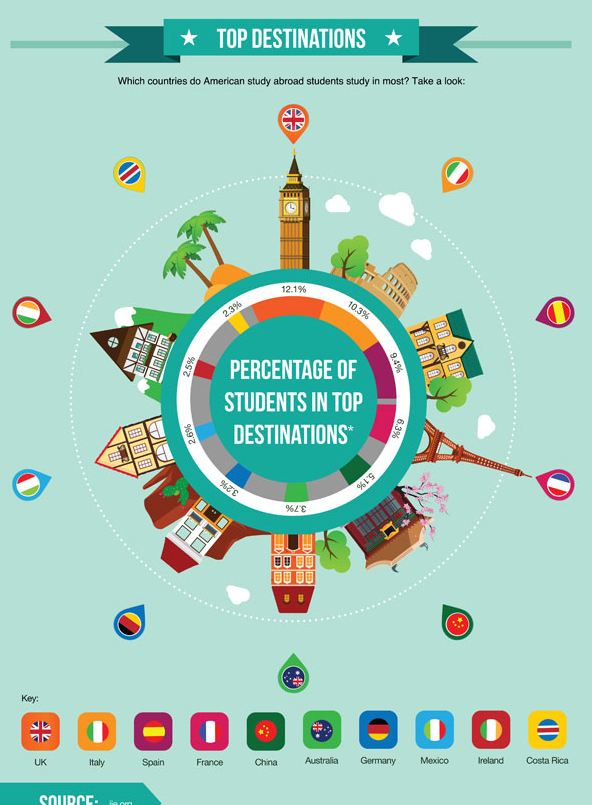
Studying abroad is a great way to find growth, career inspiration, and great experiences, but so many students today don’t get to experience this type of learning. In fact, only 1% of all students enrolled in higher education institutions today choose to study abroad. 

The cost of travel, fear, and an unwillingness to miss out on precious time at school are major reasons why so many students never go overseas for education, but we’d like to see students overcome these obstacles and enjoy the benefits of learning in another country.

Read on to learn why studying abroad is such an important experience, and why many believe that study abroad programs should be required for higher education students today.
  1. There’s no better way to learn a language:  Students today need to be linguistically and culturally competent enough to meet the international demands of business, government, and other institutions. But colleges are struggling to graduate students that can keep up. With a study abroad experience, students are immersed in a new language, and forced to quickly adapt and learn how to communicate, a skill that is highly useful in a variety of situations back home.
  2. Students become more creative:  Whether it’s through entrepreneurship, science, or art, creativity and ingenuity are valuable skills for students to develop, and a great way to do just that is to travel abroad. According to the American Psychological Association, living abroad increases a student’s ability to be more creative.
  3. It’s a great way to discover new strengths:  Studying abroad presents students with new situations on a regular basis, offering opportunities for learning new skills, solving problems, and resolving challenges that may not have been experienced at home. This experience can help students become more adaptable to new situations when they came home.
  4. Study abroad students are simply more employable:  Research from GO GLOBAL! indicates that nearly every time, students with study abroad experience will be hired over those who have not gone abroad. This is especially true for students pursuing careers in business. Employers can appreciate that students have taken the extra step to not just travel abroad, but to study in another country, learning a new language, culture, and way of life.
  5. They get promoted faster, too:  Students who not only study abroad, but work abroad, have a major advantage over their peers. A Forbes article indicates that candidates with foreign experience in China and Brazil get a major boost when it comes to promotion, as much as a year or two faster on the promotion track.
  6. The State Department desperately needs candidates with study abroad experience:  Study abroad programs offer Americans benefits in the form of experience and language skills, skills that can be put to use for national security in the State Department. Although the State Department has programs to help fill this need, an uptick in students who have studied abroad would offer a much better pool of applicants to choose from.
  7. Medical students can study new illnesses:  Students with international clinical rotation are exposed to illnesses and clinical presentations that they just don’t get access to in their own schools. This is incredibly helpful for public health in the case of pandemics, rare diseases, and unusual presentations.
  8. Improved communication skills:  Studying abroad isn’t just useful for developing language learning; it’s a great way to improve communication skills in general. As students navigate daily life in a foreign country, they learn how to bridge the gap between the communication they’re used to and the way native speakers communicate with one another. This experience is incredibly helpful for learning how to communicate across different cultures, at home and abroad.
  9. A break from academic routine:  After a couple years in college, some students may feel like they’re stuck in a rut and would welcome a break from daily college life. Some leave to take this break and never come back. But taking a break in the form of studying abroad could prove to be a welcome change from the routine of regular college, keeping students engaged and interested in education instead of becoming burnt out.
  10. Operating outside of defined comfort zones:  At home, students may not have the chance to take many classes outside of their area of study, but studying abroad can present this type of opportunity. Studying a new subject or developing a new skill can be scary, but it builds character and makes students more willing to take on new challenges, a skill that is incredibly valuable in the workplace and in life.
  11. Developing lifelong learning:  Lifelong learning has a host of benefits, supporting a curious, hungry mind. Studying abroad is a great way to spark a love of full-time learning. When traveling outside of their home country, students learn that even mundane experiences like grocery shopping can become educational, and visits to museums and cultural sites are seen for their true value. As these students come home, they may find that their thirst for knowledge has grown and want to spend more time exploring educational activities in their own communities.
  12. Studying abroad fosters independence:  So many students today are the product of helicopter parenting, households in which students are often too sheltered and taken care of to learn how to embrace independence. Studying abroad offers an opportunity for students to develop this independence and learn how to take care of themselves as they see just how much they can do on their own, in a foreign country no less.
  13. Study abroad is a training ground for future global leaders:   Study abroad education fosters growth and attitudes that are respectful of all countries, not just a student’s home country. According to IES Abroad, one of the goals of study abroad is to create future global leaders who are "willing to take a stand for the world’s welfare, not just what benefits a specific country." This eye-opening experience can help create a world of mutual global respect.
  14. Study abroad offers a lesson in red tape:   Every young adult can benefit from a lesson in dealing with the intricacies of red tape and administration, which they will almost certainly experience in their adult and working lives. Applying for study abroad scholarships, visas, foreign degree certifications, and more can offer an opportunity for learning to work through difficult administrative situations while still having access to helpful resources like parents and school administrators.
  15. An expanded worldview:  You can read books, study photographs, listen to music, and even video-conference with people across the world, but there’s just no substitute for actually being there. Students who study abroad can become more open-minded to the world with an insider’s perspective on another country. TransitionsAbroad.com indicated that nearly every student they surveyed, 98%, said that studying abroad helped them to better understand cultural views and biases.
  16. International networking:  Those who study abroad with students from other countries are bound to make friends along the way. Many students with study abroad experience report creating international friendships that have lasted for decades. As they create friendships with fellow international students, and even locals, study abroad participants are creating networking opportunities around the world.
  17. A refined view of the future:  It is not at all uncommon for students to change their major or take a new career direction after studying abroad. The experience allows students to get a new perspective on how the world works, while also discovering new interests and skills that might be better utilized in studies and work that are a bit different than what they originally set out to do.
  18. Better social skills:  Many students have spent their entire academic lives surrounded by other students and friends that they’ve known for years. But in a foreign country, you know almost no one, and are forced to make new friends. This skill is incredibly valuable when it comes time to join the workforce, learn how to network, and collaborate with new people in the workplace.
  19. A new perspective on domestic issues:  The country you live in isn’t the only one with great ideas, but sometimes it can be difficult to get exposed to the insight of different countries. Studying abroad allows students to get an understanding of how other countries are dealing with issues like energy and economics, knowledge that can be put to work back home.
  20. Studying abroad improves educational outcomes:  The Georgia Learning Outcomes of Students Studying Abroad Research Initiative has discovered that studying abroad, thought by some to be a distraction, is quite good for educational outcomes. They’ve found that students who study abroad perform better academically upon their return, and tend to graduate at higher rates than their peers who have not studied in another country. Requiring study abroad experiences could be a great way to help retain and improve educational outcomes for at-risk students.
 Source:  Online Universities

Join me on Facebook  and follow me on Twitter for more information and educational articles on parenting today's teenagers.

Friday, May 25, 2012

Teen House Parties: Keeping it Safe and Having Fun

End of school year celebrations!

School will be out shortly!

If you are planning to celebrate a graduation or an end of school year party, always have fun but always play it safe!

PACT Prevention Coalition of St. Johns County offers a great reminder for everyone that is planning to host a party with their kids or teens.

As parties continue to be part of the end of school year celebration for many people, PACT shares valuable information to keep our community safe.

Here are some tips to remind parents on how to host a party with adults and young people in attendance:
  • Establish firm ground rules and expectations before the party and ask your child to communicate them with his/her guests before the event.
  • Know the age of the partygoers and how they know your child.
  • Make it clear to guests that alcohol, tobacco, and other drugs are not allowed, and be sure to provide plenty of snacks and non-alcoholic beverages.
  • When a guest leaves, do not allow him/her to return. This will discourage guests from leaving to drink or take other drugs and later return under the influence.
PACT Prevention Coalition is part of St. Johns County community continuing to bring educational resources and information to families, schools and people in need.

PACT’s Mission: To make St. Johns County a healthy, substance-free community through the reduction and prevention of alcohol and drug abuse by our youth with Prevention, Advocacy, Choices, and Teamwork.

Join me on Facebook  and follow me on Twitter for more information and educational articles on parenting today's teenagers.

Friday, May 11, 2012

Struggling Teens: Does My Teen Need Resident Therapy?

Summer is approaching.

School is almost out.

My teen, who is very intelligent is failing.


My teen, who once had an interest in sports or music or any other hobby, is now only interested in his/her computer/technology or a group of friends that are not exactly what I would choose for him/her....

My teen is in control of our household.  Telling us when he/she will be coming home.  Telling us what their curfew is.  Total lack of respect for our boundaries.

I am not sure what to do.... Is it typical teen or is it heading done a darker path?

Only you can answer this.

From experience, I can share that many parents should exhaust all local avenues of help first including local therapy.  Unfortunately local therapy - one hour once a week rarely is enough to make substantial changes (especially with a 16 year old and up).

If you have come to a dead end, it may be time to consider residential therapy.  I always share with parents - don't wait for a crisis to happen, start your research early.  Even if you never use it, at least you are prepared if you need it.

The Internet is very confusing.  Be careful.  What is Internet fact and what is Internet fiction?  Good question.  Even with my own name and person - I have been a victim of Internet defamation and have been called all sorts of vicious names and accused of things I never did.  So you need to be careful.

I encourage you to read my story - which brought me to why I created my organization that advocates for parents that have reached their wit's end.


Join me on Facebook  and follow me on Twitter for more information and educational articles on parenting today's teenagers.